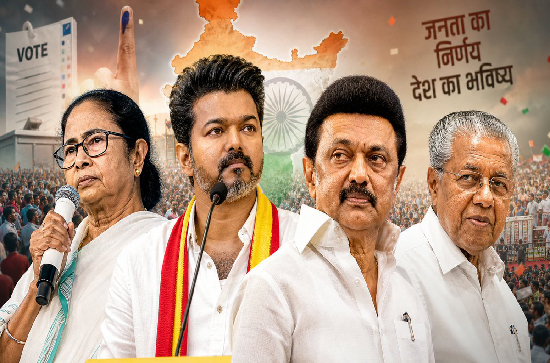
The results across West Bengal, Tamil Nadu, Assam, Kerala,, and Puducherry have delivered a clear message from the electorate, characterized by a desire for change in some regions and a consolidation of power in others.
1. West Bengal: The Fall of the Fortress
In arguably the most significant result of the decade, the Bharatiya Janata Party (BJP) has breached Mamata Banerjee’s 15-year stronghold.
-
The Outcome: The BJP secured a landslide victory, crossing the majority mark comfortably with over 200 seats in the 294-member assembly.
-
The Upset: In a stunning personal defeat, Chief Minister Mamata Banerjee lost her Bhabanipur seat to BJP’s Suvendu Adhikari by a margin of approximately 15,000 votes.
-
Impact: This marks the first time the BJP will form a government in West Bengal, signaling a major ideological shift in the state.
2. Tamil Nadu: The "Thalapathy" Storm
Tamil Nadu witnessed a historic disruption of its traditional Dravidian duopoly. Actor-turned-politician Vijay and his party, Tamilaga Vettri Kazhagam (TVK), pulled off a sensational debut.
The Rise of TVK: Stumping veteran pollsters, TVK emerged as a dominant force, leading or winning in nearly 110 seats, hovering just short of a lone majority.
The Casualty: The ruling DMK, led by MK Stalin, faced a significant setback, with Stalin himself losing his stronghold in Kolathur.
New Era: Vijay has effectively positioned himself as the primary alternative to the DMK-AIADMK era, marking the most successful political debut by an actor in the state's history.
3. Kerala: The UDF Comeback
Kerala maintained its tradition of alternating power, as the Congress-led United Democratic Front (UDF) successfully blocked the LDF’s attempt at a "hat-trick" victory.
The Mandate: The UDF swept the polls with a decisive majority, winning nearly 100 seats.
BJP’s Footprint: In a notable breakthrough, the BJP notched its best-ever performance in the state, with State President Rajeev Chandrasekhar securing a significant win in Nemom.
4. Assam: The Continuity of "Mama"
Assam chose stability over change, handing a historic third consecutive term to the BJP-led NDA.
The Victory: Chief Minister Himanta Biswa Sarma led the alliance to a commanding position, crossing the 100-mark in the 126-seat assembly
Key Themes: The campaign’s focus on identity and heritage ("Jati, Mati, Bheti") resonated deeply with the voters, leaving the Congress-led alliance far behind.
5. Puducherry: Status Quo Maintained
The Union Territory saw the return of the NDA government.
-
N. Rangasamy’s Victory: The AINRC-BJP alliance retained power, with Chief Minister N. Rangasamy winning his seat and ensuring the NDA’s continued governance in the UT.
Summary of Final Standings (Projected)
| State | Leading/Winning Party | Major News |
| West Bengal | BJP | End of TMC’s 15-year rule; Mamata Banerjee loses Bhabanipur. |
| Tamil Nadu | TVK (Vijay) | Historic debut; first non-Dravidian force to lead the state in 60 years. |
| Assam | BJP+ (NDA) | Third straight term for BJP; CM Himanta Biswa Sarma retains power. |
| Kerala | Congress+ (UDF) | UDF sweeps the polls, unseating the LDF government. |
| Puducherry | NDA | N. Rangasamy’s AINRC-BJP alliance retains the UT. |
The National Narrative
The 2026 results suggest a bifurcated political reality. While the BJP has successfully expanded its footprint into the East (Bengal) and consolidated the Northeast (Assam), the South remains a laboratory for new regional forces like TVK and a resilient Congress-led UDF.
As the "Lotus" blooms in the East, the "Thalapathy" wave in the South proves that Indian voters are increasingly willing to look beyond traditional political structures in search of new leadership.